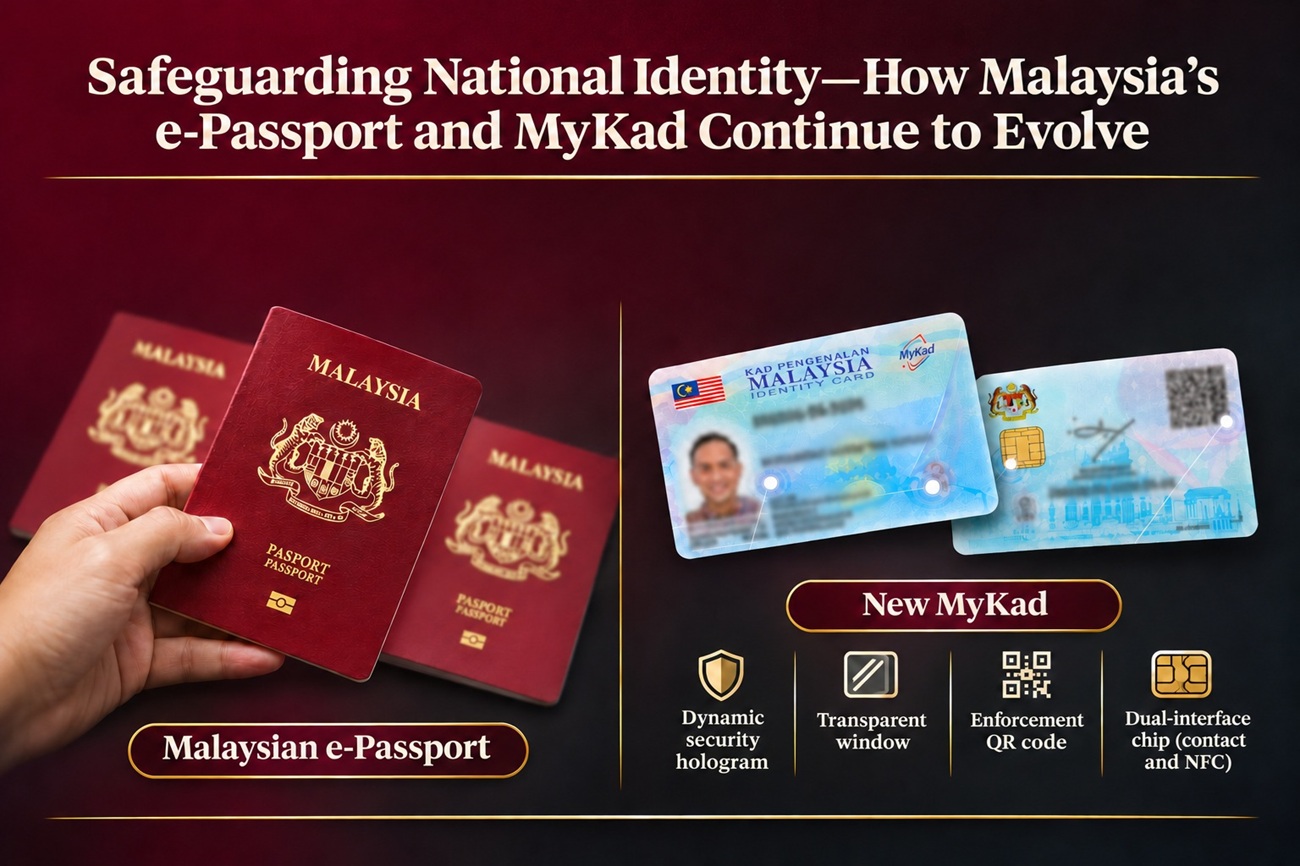
Malaysia has been recognised as an early innovator in secure identity documents. It was the first country to issue biometric passports, introducing its e-Passport in March 1998, and later launched MyKad, a chip-based multipurpose national identity card, in September 2001.
These programmes reflect Malaysia’s vision, pioneering role and continued efforts to strengthen identity verification and document security.
How an e-Passport Works
An e-Passport is a passport containing a contactless electronic chip. The chip stores the holder’s biographical details and facial image, together with a digital security feature used to check that the information was issued by the relevant authority and has not been altered.
The passport’s key details appear on its biodata page and in the machine-readable zone (MRZ), and are also stored on the chip. Border authorities can compare the printed information with the chip data.
Public Key Infrastructure (PKI) supports this process by allowing authorities to verify the chip’s digital signature and the document’s authenticity and integrity.
The check helps identify tampering; the traveller’s identity is assessed by comparing the document information with the person presenting it.
The symbol identifies a passport containing an electronic chip.
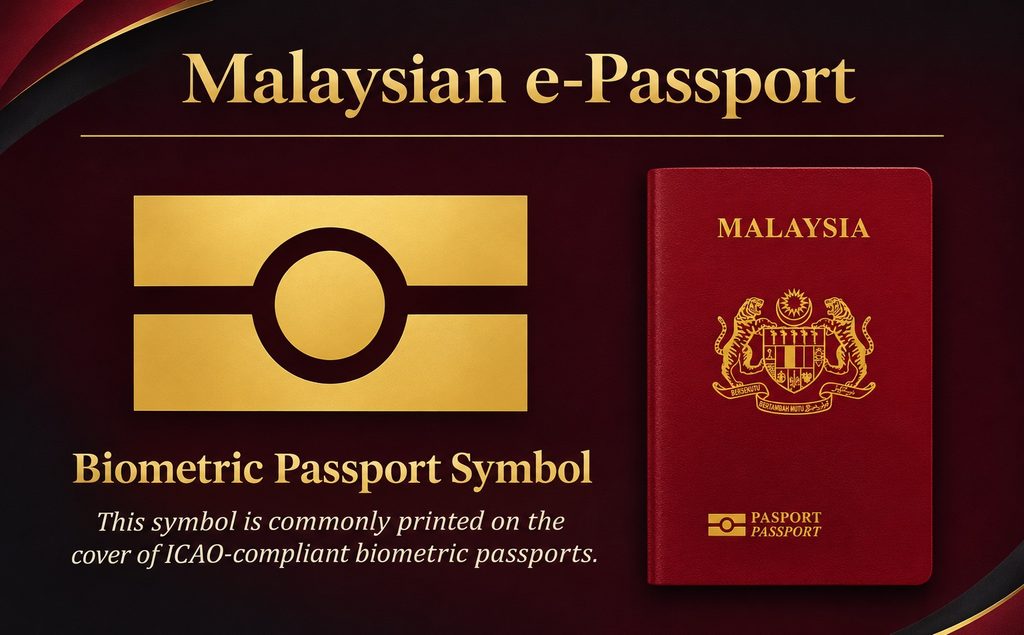
Malaysia’s Pioneering e-Passport
Developed locally by IRIS Corporation, Malaysia’s first e-Passport used a contactless 8 kB chip to store the passport holder’s personal details and photograph. Thumbprint data was added in December 2002.
The 1998 passport preceded ICAO’s international specifications for chip-enabled passports, which were adopted in 2003. It therefore used a proprietary system.
Belgium issued the first ICAO-compliant e-Passport in 2004. Malaysia launched its ICAO-version passport on 2 February 2010, moving to an open, standards-based system with PKI authentication and a higher-resolution facial image.
International adoption accelerated during the 2000s. Following the September 11 attacks, the United States’ Enhanced Border Security and Visa Entry Reform Act of 2002 required biometric identifiers in U.S. visas and other travel and entry documents.
In 2026, ICAO reported that 170 of its 193 member states had issued more than 1.5 billion electronic machine-readable travel documents.
Datasonic Group Berhad’s Role in the Passport Programme
Malaysia continued to upgrade the passport’s physical security. Laser-engraved polycarbonate biodata pages were introduced in 2013, improving durability and resistance to tampering and counterfeiting compared with laminated paper pages.
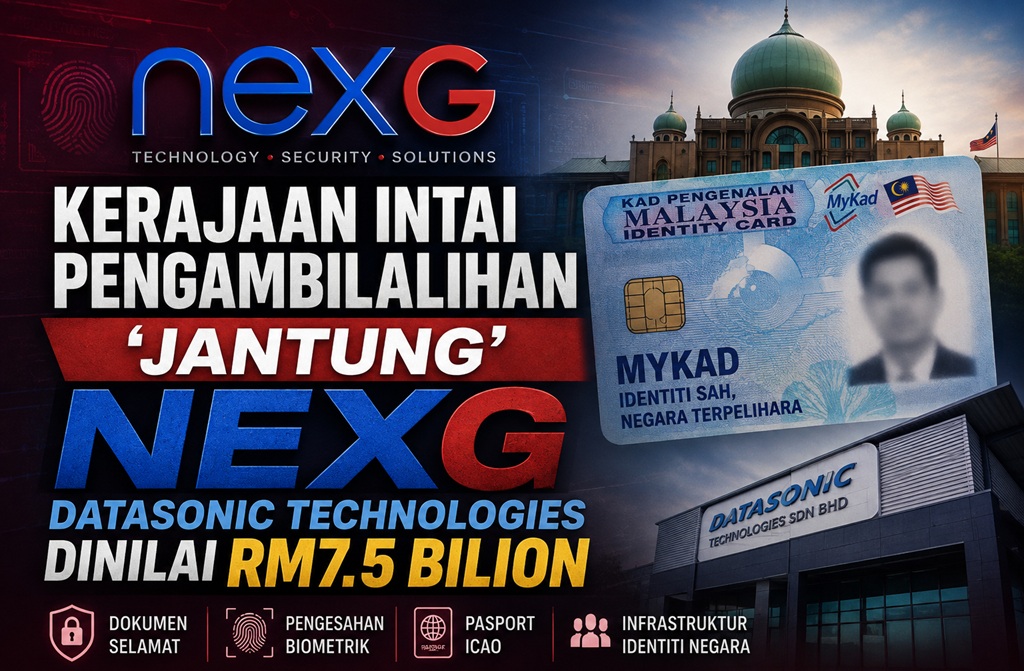
Datasonic Group Berhad (“Datasonic”) was listed on the Main Board of Bursa Malaysia on 3rd September 2012 with an Initial Public Offer of RM2.00 per share.
Datasonic has secured the contract through an open tender for the pages and associated personalisation and printing systems in 2012.
The company’s role expanded further in 2015, when it secured a contract to supply passport chips embedded in the polycarbonate pages. In 2016, Datasonic became the main contractor for printing and supplying Malaysian passports, including the booklets.
MyKad: A Pioneering Chip-Based Multipurpose National Identity Card
Malaysia began introducing MyKad in September 2001. Originally known as the Government Multipurpose Card (GMPC), it was developed under the Multimedia Super Corridor initiative to bring identity credentials and multiple public and commercial applications together on one card.
The first MyKad used a 32 kB chip, later expanded to 64 kB. Its applications included national identification, driving-licence information, biometric verification, digital signatures, and selected payment and public-service functions. MyKad’s design and chip technology were updated in 2012.
Datasonic has supplied MyKad personalisation systems and consumables through its holding company, Dibena Enterprise Sdn Bhd, since 2001 under the Government Multipurpose Card Consortium (“GMPC”).
Dibena Enterprise Sdn Bhd served as chairman of the five-member consortium, with each member responsible for a specific scope of work. IRIS Corporation served as deputy chairman and was responsible for supplying the raw cards with chips, operating system and applications.
In 2012, following an open tender, Datasonic secured a contract to supply MyKad cards, chips and consumables.
Malaysia began issuing a new-generation MyKad on 17 September 2026. It features enhanced security and a dual-interface chip that supports both contact and contactless use.
Prestigious International Recognition
Malaysia’s secure-document programmes have received international recognition. In 2018, the Malaysian e-Passport received the Regional ID Document of the Year award at the High Security Printing Asia conference in Hanoi. The award recognised the passport programme and the organisations involved in its development and implementation.
MyKad received the Best Security & Authentication Program award at the Smart Card & Payment Asia awards in 2012 and 2013. In 2015, the National Registration Department (JPN) received the Radiant Vision Award and Radiant Service Award from the Asia Pacific Smart Card Association for the MyKad programme. Datasonic supported JPN in receiving these awards.